The Victorian afternoon tea is one of Britain’s most enduring cultural exports—a ritual of delicate porcelain, tiered cake stands, and polite conversation that still captivates imaginations worldwide. Yet beneath the lace doilies and silver strainers lies a story of imperial trade, botanical curiosity, and culinary adaptation. Central to many 19th-century menus was jasmine tea, a scented green tea borrowed from China and reinterpreted through British tastes. This article reconstructs authentic Victorian-era recipes and serving practices that featured jasmine tea, drawing on period cookbooks, trade records, and household manuals. We will explore how a Fujian province specialty became a fixture in Mayfair drawing rooms, why it appealed to the era’s sensibilities, and how modern tea enthusiasts can recreate these historic blends and pairings at home.
The Arrival of Jasmine Tea in Britain: Trade Routes and Early Adoption
Jasmine tea (Chinese: 茉莉花茶, mòlì huā chá) is produced by scenting green or occasionally white tea leaves with fresh jasmine blossoms, a technique perfected in Fujian during the Song dynasty (960–1279) and refined under the Ming. By the early Qing era, it was a court favorite and a major export. British merchants first encountered it in Canton (Guangzhou) through the Canton System, where the East India Company held a monopoly until 1834.
The Canton Register of 1831 lists “jasmine-scented green tea” at 45–60 taels per picul (approximately 133 lbs), positioning it as a premium item above everyday hyson but below the rarest white teas. When the monopoly ended, private firms like Jardine Matheson flooded London docks with jasmine chests packed in lead-lined wooden boxes to preserve the volatile floral oils.
By the 1840s, jasmine tea appeared in London tea warehouses under romanticized names: “Jasmine Pearl,” “Night-Blooming Flower Tea,” or simply “Moklee.” The Illustrated London News (1851) described it as “a perfume rather than a beverage,” capturing the era’s fascination with olfactory luxury. Its adoption coincided with the craze for Chinoiserie interiors—Willow pattern china, pagoda motifs, and lacquered tea caddies—all of which framed jasmine tea as an exotic yet accessible indulgence.
Jasmine Tea in the Victorian Social Hierarchy
Afternoon tea, formalized by Anna Russell, Duchess of Bedford, around 1840, initially featured black teas—Assam, Ceylon, and Keemun—robust enough to pair with clotted cream and fruit preserves. Green teas, including jasmine, entered the repertoire later, around the 1860s, as health concerns about over-fermented black tea grew. Isabella Beeton’s Book of Household Management (1861) devotes a full page to “Chinese Green Teas,” praising jasmine for its “delicate fragrance and absence of astringency.”
Upper-class households reserved jasmine for the “second brew” of the afternoon—served after hearty sandwiches when conversation turned intimate. Middle-class families, emulating their betters, purchased it in smaller ¼-lb foil packets from grocers like Fortnum & Mason, whose 1886 catalogue priced “Finest Jasmine” at 10s. 6d. per lb—triple the cost of congou but affordable for a monthly treat.
Working-class adopters were rarer but not absent. Temperance advocates promoted jasmine tea in Mechanics’ Institutes as a refined alternative to gin, diluting it with milk and sugar to stretch limited wages. Thus, the same Fujian leaves traversed class lines, adapting to each stratum’s budget and palate.
Reconstructing a Victorian Jasmine Tea Service: Equipment and Etiquette
A faithful reconstruction requires period-appropriate tools:
| Item | Description | Modern Substitute |
|---|---|---|
| Teapot | Yixing clay or brown Betty earthenware (6–8 cup capacity) | Ceramic kyusu or Brown Betty replica |
| Kettle | Copper or brass, goose-neck spout for controlled pouring | Electric temperature-controlled kettle set to 80 °C |
| Cups | Bone china, handleless “tea bowls” or low-handled cups | Vintage-style bone china |
| Strainer | Perforated silver with ebony handle | Fine mesh infuser basket |
| Caddy spoon | Shell-shaped, 1 tsp capacity | Standard measuring spoon |
Etiquette notes from Emily Thornwell’s The Lady’s Guide to Perfect Gentility (1856):
- Never fill a cup more than two-thirds full—allows room for milk.
- Stir gently in a back-and-forth motion; circling is “vulgar.”
- Offer lemon only with plain green tea; jasmine is served black or with a single lump.
Core Recipe 1: Victorian-Style Jasmine Tea (1860s Mayfair Blend)
Source: Adapted from Cassell’s Dictionary of Cookery (1875) and Fortnum & Mason warehouse ledgers.
Ingredients (serves 6):
- 3 tsp high-grade jasmine-scented green tea (modern equivalent: Fujian Jasmine Dragon Pearls)
- 1.5 pints (850 ml) soft water, freshly drawn
- Optional: 1 tsp orange blossom water (added by some hostesses for extra perfume)
Method:
- Preheat the teapot with boiling water; discard.
- Measure tea into the pot using a caddy spoon—1 tsp per person plus “one for the pot.”
- Heat water to 80 °C (just off the boil; small bubbles like “crab eyes” in Chinese parlance).
- Pour water over leaves and steep exactly 2½ minutes—no longer, lest bitterness emerge.
- Strain into cups. Serve black or with a single lump of sugar (never milk; it masks the jasmine).
Historical note: Victorian water was often hard and chalky; modern filtered or spring water replicates the soft Yorkshire water preferred by London blenders.
Core Recipe 2: Jasmine Tea Punch (Temperance Version, 1880s)
Source: The Temperance Cookbook by Mrs. E. E. Marcy (1882).
Ingredients (serves 12):
- 6 tsp jasmine tea leaves
- 1 quart (1.1 L) boiling water
- 1 pint (570 ml) clear apple juice
- 4 oz (115 g) loaf sugar
- Juice of 2 lemons + thin slices for garnish
- 1 small bunch fresh mint
Method:
- Infuse tea in boiling water for 4 minutes; strain.
- Dissolve sugar in the hot tea.
- Cool completely, then add apple juice and lemon.
- Chill over a block of ice in a punch bowl; float mint and lemon slices.
- Serve in glass cups—no alcohol, suitable for chapel teas.
This punch illustrates how jasmine’s perfume stretched to non-alcoholic social beverages, rivaling sherry cup in popularity.
Food Pairings: What the Victorians Ate with Jasmine Tea
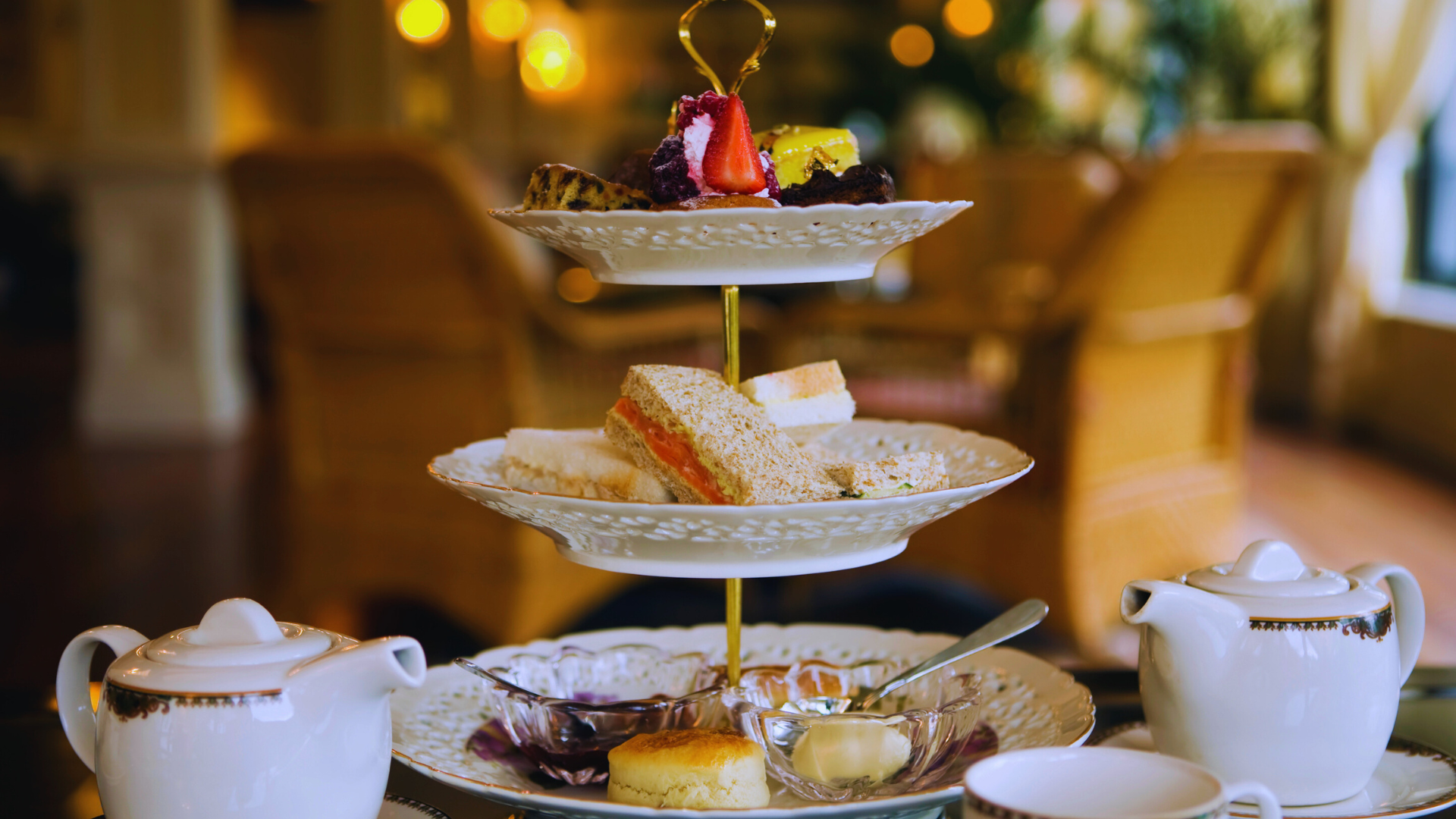
Jasmine’s floral top notes demanded light, buttery, or citrus accompaniments. From surviving menus at Chatsworth House (1879) and the Langham Hotel (1865):
Tier 1 – Savories
- Cucumber sandwiches on paper-thin brown bread, crusts removed.
- Egg and cress sandwiches bound with saline butter.
- Anchovy toast fingers – a briny contrast that “sets off the jasmine perfume,” per The Lady’s Realm (1891).
Tier 2 – Scones
- Plain scones with Devonshire cream and strawberry jam.
- Orange flower scones – scented to echo jasmine (recipe below).
Tier 3 – Sweets
- Madeira cake – dense, lemon-zested.
- Almond macaroons dipped in jasmine syrup.
- Candied ginger or violet petals for a final aromatic flourish.
Orange Flower Scone Recipe (adapted from Eliza Acton, 1845):
- 8 oz (225 g) self-raising flour
- 1 oz (30 g) caster sugar
- 2 oz (55 g) butter
- 1 tsp orange flower water
- 4 fl oz (120 ml) milk Rub butter into flour, add sugar and flower water, bind with milk. Cut into 2-inch rounds, bake 12 minutes at 220 °C. Split and serve warm.
Regional Variations: Scotland, Ireland, and the Colonies
In Edinburgh, jasmine was often blended 50:50 with Lapsang Souchong for a smoky-floral hybrid favored by literary salons. Dublin hostesses added a dash of Irish whiskey to jasmine punch during private “at homes,” technically breaching temperance but winked at in Catholic circles.
Colonial outposts adapted further. In Calcutta, the Civil & Military Gazette (1872) records “jasmine iced tea” served on verandas—brewed double strength, chilled, and poured over pineapple ice. Hong Kong’s Peak residences used local jasmine blossoms to “refresh” imported leaves that had lost scent during monsoon voyages.
Health Claims and Pseudoscience
Victorian magazines overflowed with dubious benefits. The Family Herald (1867) claimed jasmine tea “soothes hysterical tendencies” in women, while Dr. John Milner Fothergill’s Food for the Invalid (1880) prescribed it for “nervous dyspepsia.” These assertions stemmed from Chinese medical texts translated by missionaries, filtered through British sensibilities. Modern science validates only the mild caffeine and L-theanine synergy—calming yet alerting, ideal for 4 p.m. slumps.
Sourcing Authentic Leaves Today
For reconstruction accuracy, seek:
- Base tea: Mao Feng or Bi Luo Chun green tea scented over 5–7 nights with fresh jasmine (avoid artificial “jasmine flavor”).
- Vendors: Marriage Frères (Paris), Teapod (Hong Kong), or direct from Fujian cooperatives via Alibaba with COA for pesticide levels.
- Storage: Airtight tin, away from light and spice cupboards; jasmine oils volatilize within 12 months.
Step-by-Step Modern Reconstruction Menu (Serves 8)
Timeline (90 minutes total):
- −60 min: Brew jasmine punch base; chill.
- −30 min: Bake orange flower scones.
- −15 min: Assemble sandwiches.
- 0 min: Warm teapot, measure tea, heat water to 80 °C.
- +5 min: First pot of hot jasmine tea.
- +20 min: Serve punch as interlude.
- +40 min: Second pot with sweets.
Shopping list (historic quantities):
- 2 oz jasmine dragon pearls
- 1 loaf brown bread, 1 cucumber, 4 eggs, watercress
- 1 pint clotted cream, ½ pint strawberry jam
- 1 bottle pressed apple juice, 2 lemons, fresh mint
- Ingredients for scones + Madeira cake (or purchase)
Conclusion: A Trans-Imperfect Legacy
Jasmine tea in Victorian afternoon tea was never a pure Chinese artifact; it was a hybrid—Fujian leaves, Cantonese scenting, British blending, and imperial logistics. Its presence on three-tiered stands symbolizes the 19th-century British talent for domesticating the exotic while preserving just enough mystery to enchant. Reconstructing these recipes today is not mere nostalgia; it is an act of culinary archaeology that reconnects us to global trade networks, gender rituals, and sensory pleasures that shaped modern tea culture.
Next time you scent the air with jasmine steam at 4 p.m., imagine a whale-boned hostess in Belgravia doing the same—her world separated from ours by empire and etiquette, yet united by the fragile perfume of night-blooming flowers carried across oceans in wooden chests.
